
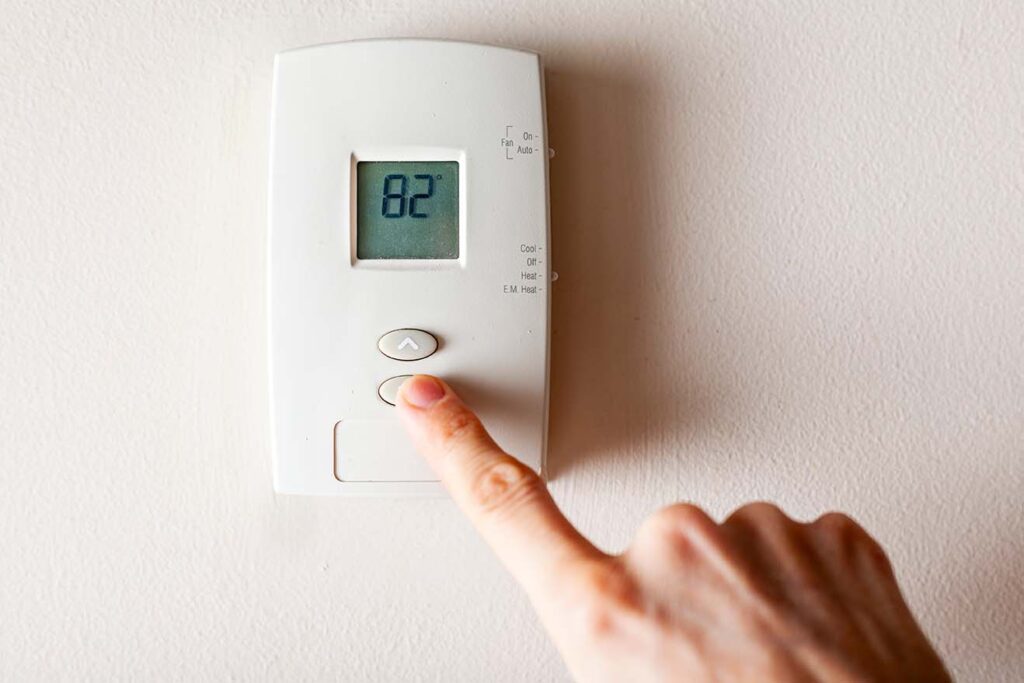
An Quick Answer: An air conditioner running constantly may not be a problem with the AC unit — it most certainly your home’s thermal envelope. In Westchester County and throughout the Hudson Valley, most homes that lose the battle against summer heat share the same underlying issues: inadequate attic insulation that lets radiant heat pour through the ceiling, missing air sealing at penetrations and the rim joist, and wall insulation that has settled or degraded over time. When hot outdoor air freely enters through these gaps, no air conditioner can overcome the heat load regardless of its size or efficiency rating. Metro NY Insulation identifies specific air leakage and insulation deficiencies using blower door testing and professional home energy assessments. New York homeowners may qualify for up to $3,000 in rebates through the NYSERDA Comfort Home Program to cover insulation and air sealing packages.
Your AC Isn’t the Problem. Your House Is.
You’ve checked the air filter. You’ve had the unit serviced. The technician says everything looks fine. But the AC still runs from morning until night — and the upstairs bedrooms feel like a sauna by 4 pm.
The unit isn’t the problem. The house is.
More specifically, the problem is how fast outdoor heat is entering your home — and whether your AC can remove it faster than it arrives. Understanding that equation is the key to actually fixing the comfort problem, rather than chasing it with a bigger air conditioner that will deliver exactly the same result.
Your AC Can’t Win Against a Leaky Building Envelope
An air conditioner works by removing heat from indoor air and moving it outside. It does this remarkably well — when the battle is fair.
The problem is that most homes in Westchester County and the Hudson Valley were built before modern energy codes. That means attics with R-11 fiberglass batts when current standards call for R-49 to R-60. It means rim joists — the band of framing where your floor meets the foundation walls — that were never air sealed, creating a ring of infiltration around the entire base of your home. It means decades of settling and degradation in whatever insulation was originally installed.
Every degree of heat that enters through those gaps is work the AC has to undo. When enough heat is coming in fast enough, the system runs continuously just to hold even — and the moment it cycles off, the temperature climbs right back. That’s the cycle you’re living in. And adding a bigger AC unit doesn’t fix it — it just means a bigger unit running constantly instead of a smaller one.
Your Attic Is Acting Like a Furnace
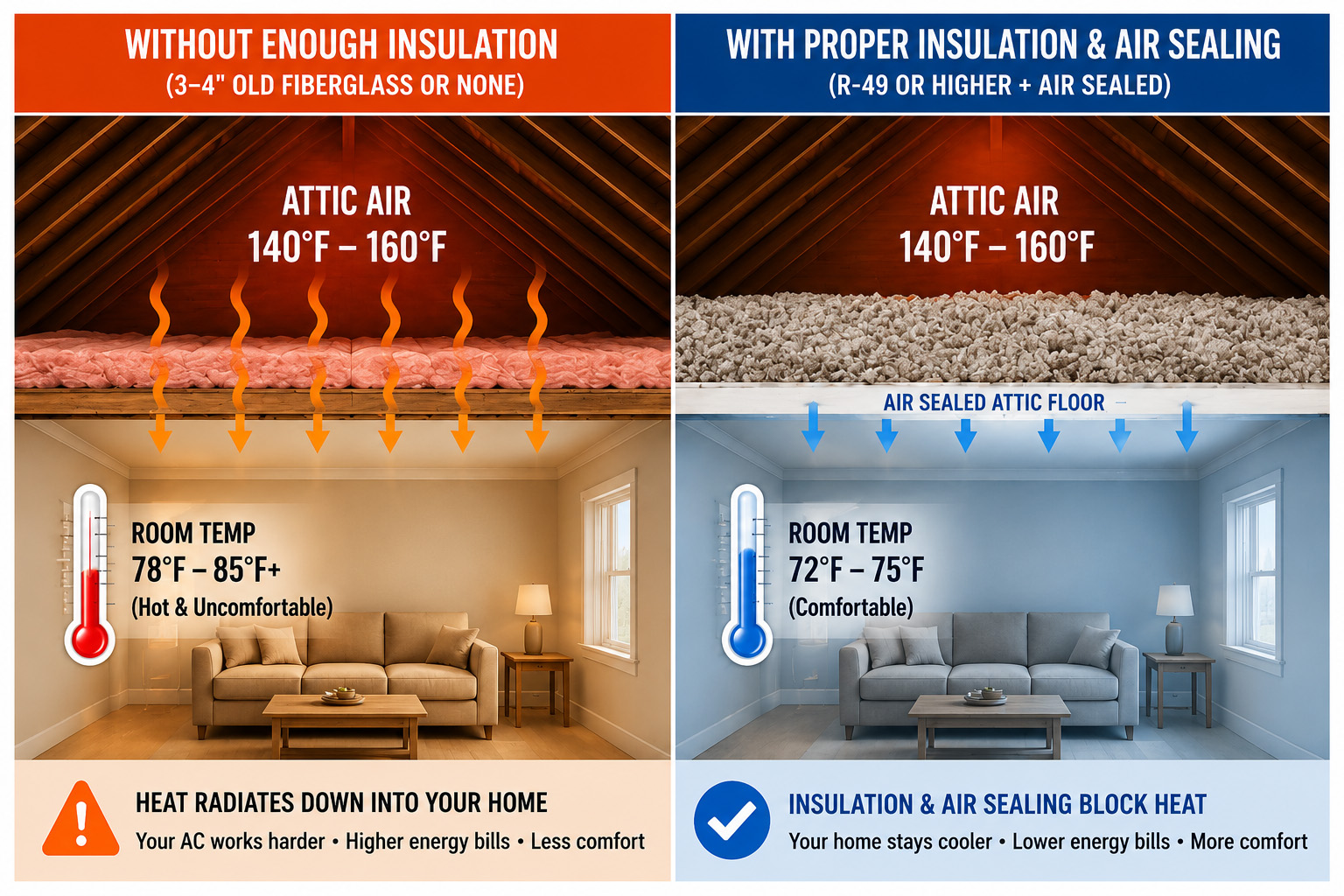
On a sunny summer afternoon, the air temperature in an uninsulated or under-insulated attic can reach 140°F to 160°F. That is a documented temperature range measured in homes throughout the Northeast — not an exaggeration.
That heat doesn’t stay in the attic. It radiates downward through the ceiling into your living space at a rate determined almost entirely by how much insulation sits between the attic floor and your rooms below. If you have three to four inches of old fiberglass batting — or nothing at all — your home is essentially in direct contact with a 150-degree heat source all afternoon.
Proper attic insulation, typically blown-in cellulose to R-49 or higher in our climate zone, combined with thorough air sealing at the attic floor, creates a genuine thermal barrier. The attic still gets hot. But your home doesn’t feel it — and your AC doesn’t have to fight it.
Air Leaks Are Multiplying the Problem
Insulation slows heat transfer. Air sealing stops it. These two things work together — and without both, neither performs as well as it should.
A home with good insulation but significant air leaks will still have its AC running constantly because conditioned air is escaping and hot outdoor air is replacing it continuously through gaps you cannot see. The most common air leakage points we find in homes throughout our service area include:
- The rim joist, where floor framing meets the foundation — often completely open to the outdoors
- Recessed lighting fixtures in ceilings with attic space above
- Plumbing and electrical penetrations through top plates
- Attic hatch openings with no insulation or weather stripping
- Gaps behind knee walls in cape-style and colonial homes
A blower door test quantifies exactly how much air your home is leaking, measured in air changes per hour (ACH). Most older homes in our service area test at 5 to 10 ACH or higher. A well-sealed home should be under 3 ACH. That difference represents hundreds of cubic feet of conditioned air escaping — and hot air flooding back in — every hour your AC runs.
What a Home Energy Assessment Reveals
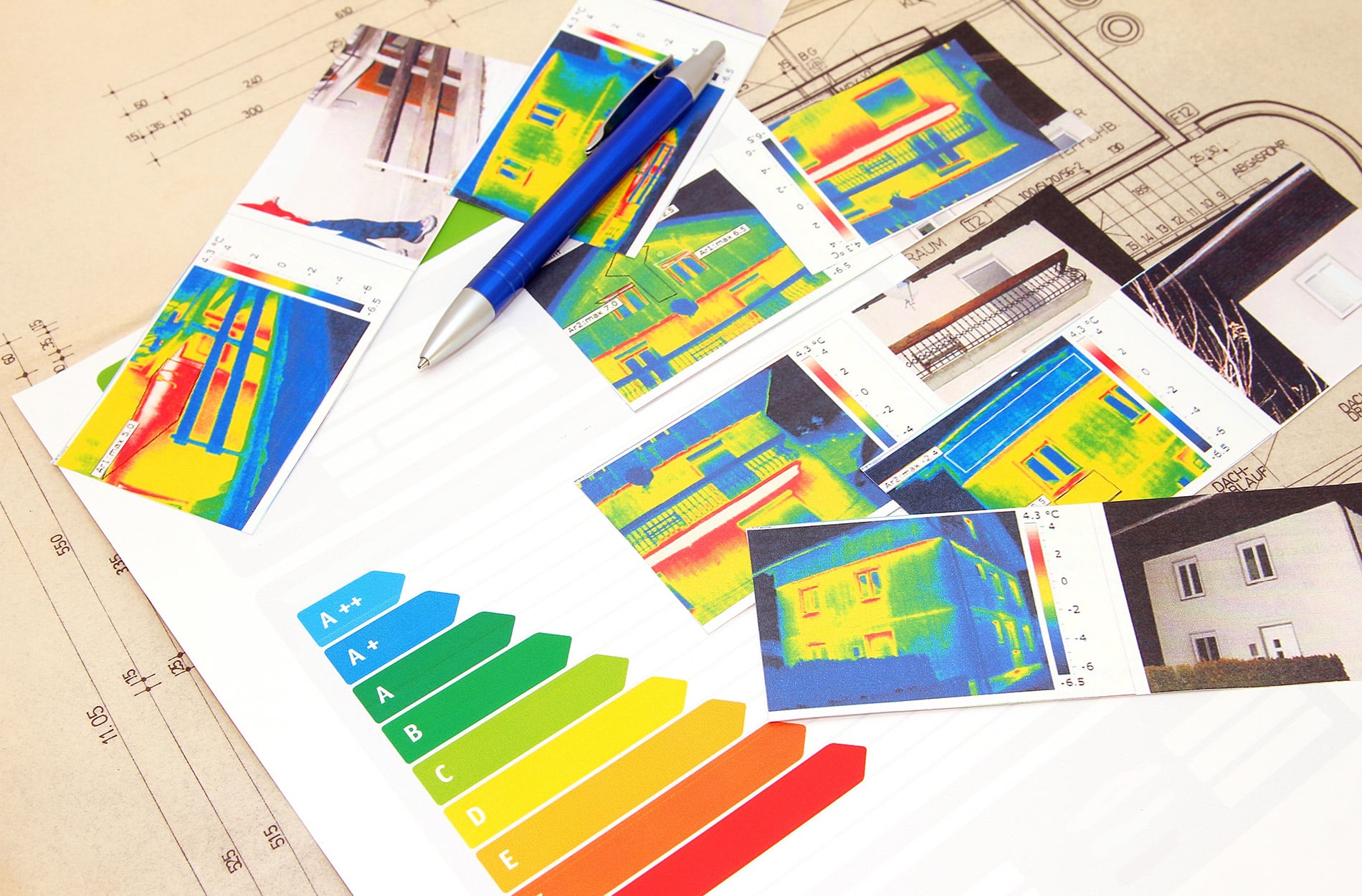
A professional home energy assessment is the diagnostic tool that turns guesswork into a specific scope of work. During an assessment, a certified energy auditor uses a blower door to pressurize the home and identify exactly where air is leaking — often using a thermal camera to visualize temperature differences in real time. They also document existing insulation levels in the attic, walls, and crawl space, and review utility bills to quantify the baseline energy cost.
The result is a report that tells you specifically what’s wrong, what to fix first, and what the expected savings look like. For New York homeowners, completing a qualifying home energy assessment is also the first step in accessing NYSERDA Comfort Home Program rebates — so the assessment is not just diagnostic, it’s the gateway to meaningful financial incentives.
Metro NY Insulation offers home energy assessments as part of our full-service approach, and we operate as a NYSERDA participating contractor — meaning we take you from assessment to installation to rebate processing as a single coordinated project.
How Insulation and Air Sealing Actually Fix It
Once the diagnostic work is done, the fix is straightforward: seal the air leaks, bring the insulation to current standards, and address any secondary issues — rim joist, knee walls, crawl space — identified during the assessment.
A typical project for a home with significant summer comfort issues in our area includes:
- Attic air sealing at penetrations, top plates, recessed lights, and the attic hatch
- Blown-in cellulose to bring attic insulation to R-49 to R-60 (current code minimum for our climate zone)
- Closed-cell spray foam at the rim joist around the home’s perimeter
- Dense-pack cellulose in exterior walls where significant deficiencies are found
After this work, most homeowners notice two things immediately: the AC cycles on and off normally rather than running without interruption, and upstairs bedrooms stay within two to three degrees of downstairs temperatures even on the hottest afternoons of the year.
For New York homeowners, the NYSERDA Comfort Home Program provides rebates of up to $2,500 for attic and rim joist packages, and up to $3,000 for full home performance packages. The program runs year-round — summer projects qualify on the same terms as fall or winter projects. There is no seasonal deadline. The program is available throughout Westchester, Rockland, Orange, Dutchess, and Ulster counties.
Insulation and Air Sealing Services in Westchester County and NJ
Metro NY Insulation provides attic insulation, air sealing, cellulose insulation, spray foam insulation, wall insulation, rim joist insulation, crawl space encapsulation, and home energy assessments throughout the following areas:
- New York: Westchester County, Rockland County, Orange County, Dutchess County, Ulster County, and Sullivan County — including White Plains, Yonkers, New Rochelle, Scarsdale, Tarrytown, Ossining, Peekskill, Mount Vernon, Rye, Larchmont, Mamaroneck, Harrison, Armonk, Chappaqua, Katonah, Pleasantville, Dobbs Ferry, Irvington, Hastings-on-Hudson, Croton-on-Hudson, Nyack, Spring Valley, Suffern, Newburgh, Poughkeepsie, Kingston, and surrounding communities
- New Jersey: Bergen County, Essex County, Passaic County, Hudson County, Morris County, and Union County — including Fort Lee, Teaneck, Hackensack, Montclair, Newark, Parsippany, Morristown, Hoboken, and surrounding communities
📞 (845) 445-8255
Schedule a Free Assessment →
Related reading: The best insulation to keep your home cool in summer