
How to Check Your Attic Insulation
Quick Answer: If your home feels too hot in summer, too cold in winter, or your energy bills keep rising, your attic insulation may be the problem. Check for uneven coverage, exposed joists, compressed insulation, moisture, drafts, or low depth. Most NJ and NY homes need R-38 to R-60 in the attic depending on insulation type.
Every summer it's the same routine in homes across Bergen County, Essex County, and Westchester. The AC runs from noon until midnight. The second floor is ten degrees hotter than the first. The energy bill climbs. And the first instinct is to call the HVAC company — to get the system serviced, the refrigerant checked, the ducts inspected.
Here's what's usually not the problem: the HVAC system. Here's what usually is: the attic.
When attic insulation is thin, compressed, or missing in key areas, your heating and cooling system is fighting a losing battle. Heat pours in through the attic floor in summer. Heat escapes through it in winter. The system runs constantly not because it's broken, but because the insulation isn't doing its job. And the attic almost never gets inspected — it sits untouched for decades while homeowners replace windows and service furnaces. Fortunately, a basic inspection doesn't require specialized tools or professional training. Here's how to check your attic insulation, what to look for, and what the results mean for your home's comfort and energy performance.
Why Attic Insulation Matters More Than Most Homeowners Realize
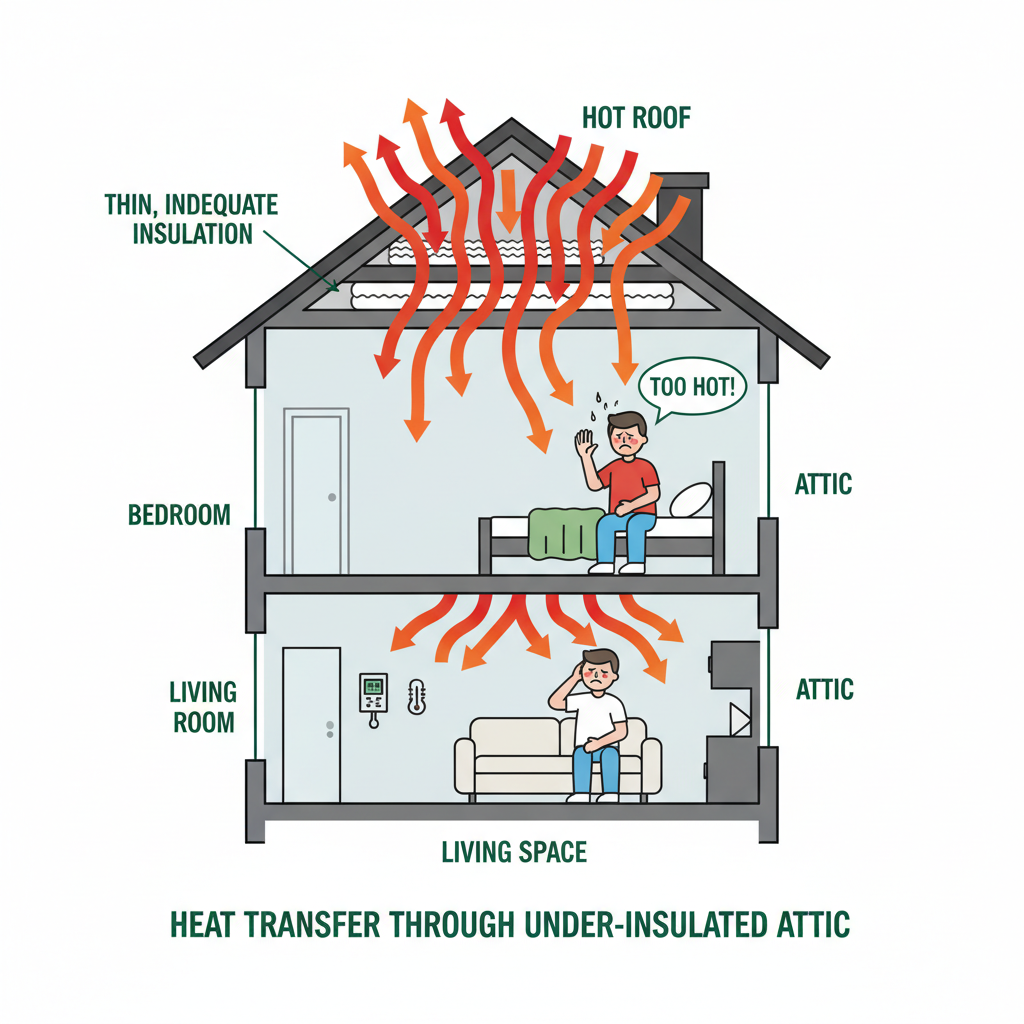
The attic sits at the top of your home's thermal envelope — the boundary between your conditioned living space and the outside world. What happens there determines how comfortable your home is and how hard your HVAC system works to keep it that way.
In winter, heat rises and escapes through an under-insulated attic floor. Your furnace runs longer, the top floor stays colder, and the bill goes up. In summer, the dynamic reverses. Your roof surface can reach 150 degrees F or higher on a sunny day. That heat radiates downward through the attic floor into the rooms below — and your air conditioner works against that constant load all afternoon and evening, often without catching up.
Ice dams are another consequence. When heat escapes unevenly through the attic floor, it warms the roof deck, melts snow at the surface, and refreezes at the colder eaves. It's a recurring problem in Bergen County, Passaic County, and Westchester County — and it's almost always an insulation issue, not a roof or gutter problem.
Signs Your Attic Insulation May Not Be Working Properly
You don't need to go into the attic to notice these symptoms. They show up in how your home feels and how much it costs to run.
- Upstairs rooms are consistently hotter than downstairs — especially on warm afternoons, even with the AC running
- Your home feels drafty in winter near the ceiling on the top floor, even with windows and exterior doors closed
- Heating and cooling bills are increasing without a corresponding change in how much you're using the system
- Certain rooms never reach a comfortable temperature regardless of thermostat setting
- Your HVAC runs almost constantly in both summer and winter without ever catching up
- Ice dams form on your roof in winter — a direct signal that heat is escaping through the attic unevenly
- You notice a temperature difference near the ceiling versus mid-room on upper floors — warmer at the ceiling in winter, hotter in summer
- Rooms heat up quickly on sunny afternoons even with blinds closed — a sign that radiant heat from the attic is penetrating through the ceiling
If you're experiencing three or more of these symptoms in a home built before 1980, the attic insulation is the most likely cause.
How to Safely Inspect Your Attic Insulation
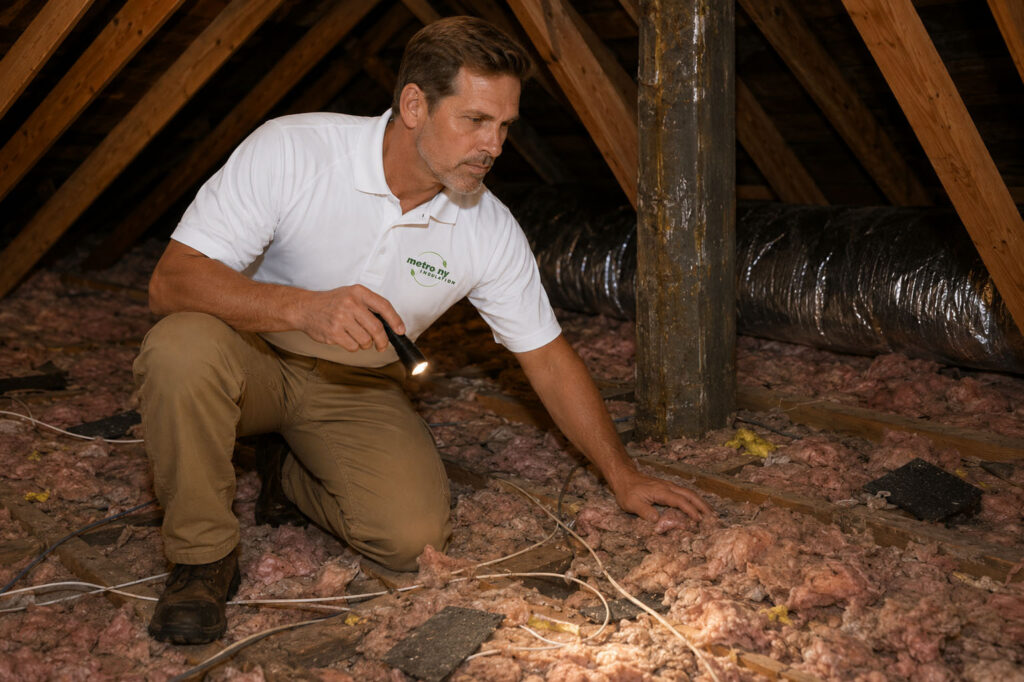
Before you go up, gather a few basics: a flashlight or headlamp, a tape measure, a dust mask (N95 preferred), work gloves, and long sleeves. Old insulation — especially fiberglass — can be irritating to skin and lungs. Once you're prepared, the inspection itself takes about fifteen minutes.
Step 1 — Check Insulation Depth
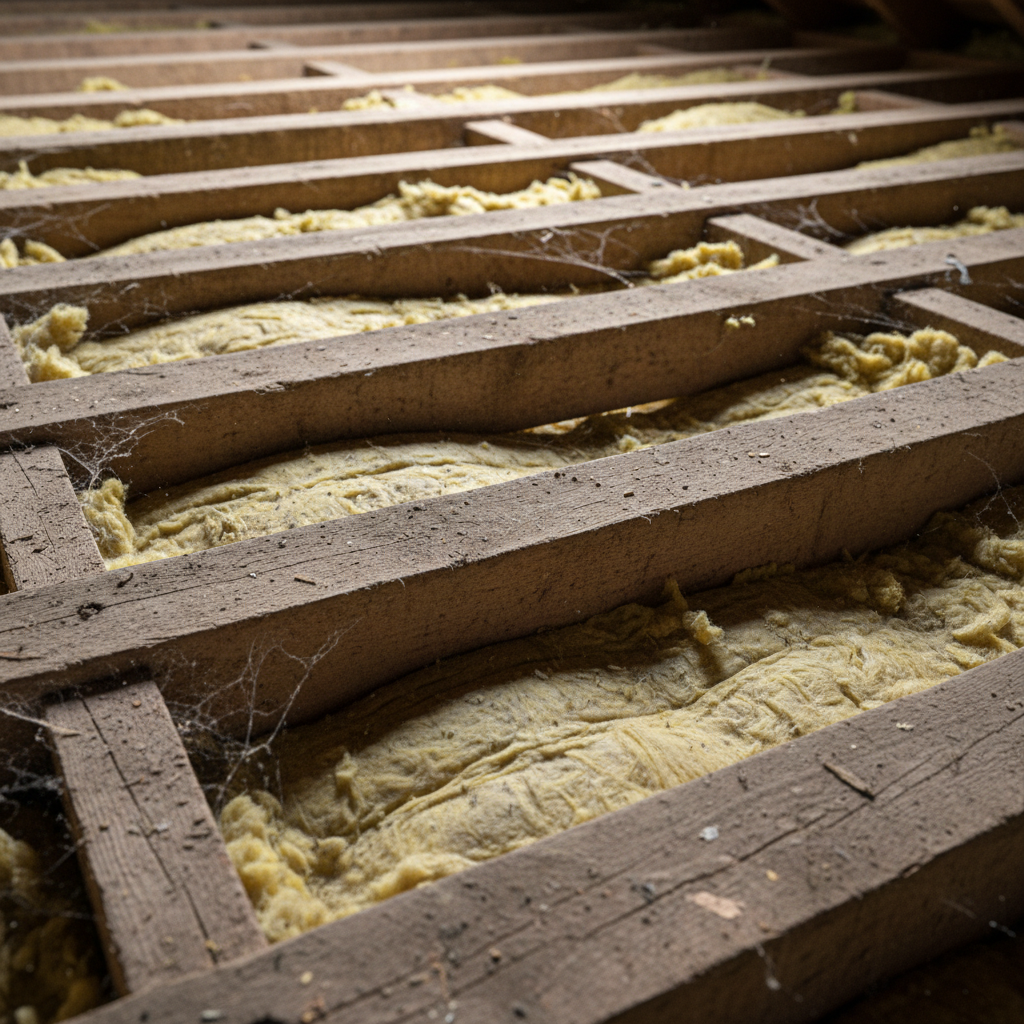
Shine your flashlight across the attic floor. The first thing you're looking for is whether you can see the tops of the floor joists — the wood framing members running across the attic floor.
If joist tops are visible, your insulation depth is below what the framing allows. Joists in most pre-1980 homes are either 2x6 (5.5 inches deep) or 2x8 (7.5 inches deep). If your insulation is flush with or below those joists, you're likely looking at R-11 to R-19 — well short of the R-49 minimum recommended for IECC Climate Zone 5A, which covers all of New Jersey and Westchester County.
Use your tape measure to check actual depth in at least three spots: the center of the attic floor, close to the eaves, and near the attic access opening. Depth often varies significantly across the same attic, and the edges and access point are almost always the worst spots.
Real scenario: A homeowner in Montclair, NJ with a 1964 colonial measured her attic and found just 4 inches of compressed fiberglass — an estimated R-11, compared to the R-49 her home needs. Her upstairs bedrooms ran 10 degrees F hotter than the first floor every summer.
Use this table to match depth to approximate R-value for different insulation types:
| Insulation Type | Depth for R-38 | Depth for R-49 | Depth for R-60 |
|---|---|---|---|
| Blown-in fiberglass | ~12 in | ~16 in | ~20 in |
| Blown-in cellulose | ~11 in | ~14 in | ~18 in |
| Fiberglass batts | ~12 in | Requires layering | Requires layering |
Step 2 — Look for Gaps or Bare Areas
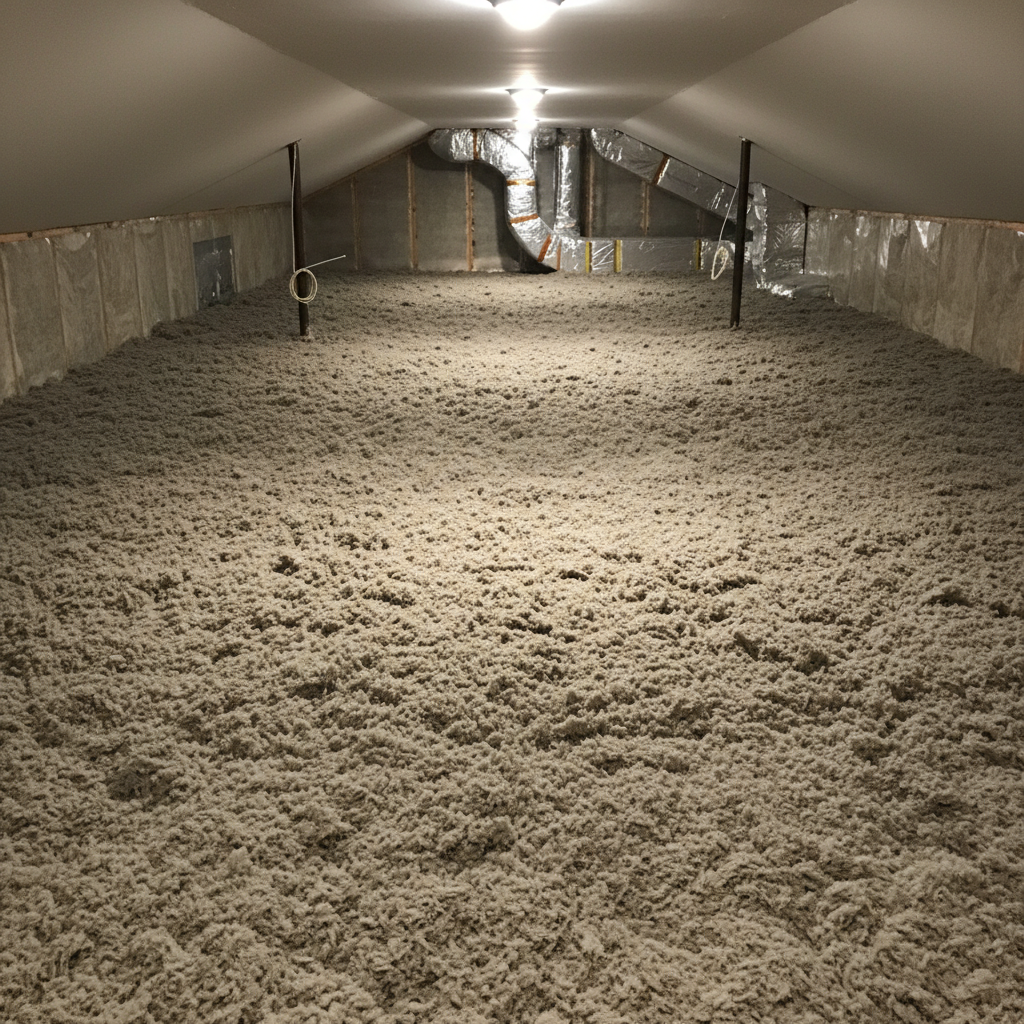
Even when average depth looks acceptable, gaps and bare spots defeat the purpose. These are the most common problem locations:
- The attic access hatch — almost always uninsulated or poorly insulated; one of the single biggest air and heat leakage points in a home
- Near the eaves — insulation frequently thins out or is missing entirely where the roof meets the walls
- Around recessed light fixtures — older recessed lights that poke through the attic floor are often surrounded by bare areas where insulation was pulled back to comply with (outdated) fire clearance requirements
- Alongside ductwork — wherever HVAC ducts run through the attic, insulation is often disturbed or missing
- Near storage areas — homeowners who use the attic for storage often compress or push aside insulation, creating unintentional gaps
Step 3 — Check for Moisture or Mold
Moisture is the most serious finding in an attic inspection. Look for dark staining on the wood framing or sheathing, visible mold (which appears black, green, or white and fuzzy), a musty smell when you open the access hatch, or insulation that looks matted, clumped, or darker than it should be.
Moisture in an attic comes from several sources: roof leaks, condensation when warm interior air meets cold attic surfaces, or excessive humidity migrating up from the living space. Any of these issues compromises insulation performance significantly — wet insulation loses most of its R-value — and can lead to structural damage and air quality problems over time.
If you find active moisture or visible mold, stop your inspection and call a professional before adding any insulation. Insulating over a moisture problem traps it inside the building envelope and makes it worse.
Step 4 — Look for Compressed or Damaged Insulation
Insulation loses R-value as it compresses. Fiberglass batts installed in the 1970s and 1980s may have started at R-19 but settled to R-11 or less over the decades. Blown-in material can shift and settle unevenly, leaving thin patches that weren't there when the work was originally done.
Signs to look for: insulation that appears flat, matted, or paper-thin; fiberglass batts that have shifted out of position; or any evidence of rodent activity — nesting material, droppings, or tunneling through the insulation. Rodent-damaged insulation nearly always needs to be removed and replaced rather than topped off.
Step 5 — Feel for Temperature Differences
On a warm, sunny day — ideally between 1pm and 4pm — open the attic access hatch. A properly insulated attic will still be warm, but you shouldn't feel a dramatic rush of scorching air. If the difference between your attic and the room below it is extreme, that's a direct signal that the insulation isn't doing its job.
Pay attention to the access hatch itself. If you feel a strong rush of hot air in summer or cold air in winter right at the hatch, the hatch cover is uninsulated — a quick, inexpensive fix that can make a noticeable difference on its own.
What Is R-Value and Why Does It Matter?
R-value is the measure of thermal resistance — how well a material slows the transfer of heat. The higher the R-value, the better the insulation performs. Every type of insulation has a different R-value per inch of thickness, which is why depth alone doesn't tell the whole story.
For New Jersey and Westchester County — both located in IECC Climate Zone 5A — the recommended minimum for attic insulation is R-49. Rockland County, which sits at the northern edge of the service area, can benefit from R-60 given its colder winters and elevation variability.
| Insulation Type | R-Value per Inch | Notes |
|---|---|---|
| Blown-in fiberglass | R-2.2 to R-2.7 | Common in existing attics |
| Blown-in cellulose | R-3.2 to R-3.8 | Higher density, eco-preferred |
| Spray foam (open-cell) | R-3.5 to R-3.7 | Air sealing + insulation combined |
| Spray foam (closed-cell) | R-6.0 to R-7.0 | Best for rim joists and specialty areas |
| Fiberglass batts | R-2.9 to R-3.8 | Common in pre-1980 homes |
Most older homes in NJ and Westchester have whatever was installed at original construction — typically 3 to 6 inches of fiberglass batts providing R-11 to R-19.
If you're interested in upgrade options, our guides on blown-in cellulose insulation and spray foam insulation explain how each material performs in different attic configurations. You can also learn about our professional attic insulation services in NJ and NY if you're ready to move beyond the DIY inspection.
When DIY Inspection Isn't Enough
A visual inspection tells you a lot. But there are three things homeowners genuinely can't see without professional tools, and they account for a significant portion of comfort and energy performance problems.
The first is air leakage. Gaps around wiring penetrations, plumbing stacks, recessed lights, and attic bypasses (interior wall cavities open to the attic) are invisible to the naked eye but can account for 20 to 40% of a home's total heating and cooling loss. Adding insulation over unsealed air leaks helps but doesn't fully solve the problem.
The second is thermal bridging — wood framing conducts heat even when surrounded by insulation, and structural elements can create heat pathways that don't show up as visible gaps. The third is ventilation imbalance. Attics need balanced airflow between soffit intake vents and ridge or gable exhaust vents. When insulation blocks soffit vents, moisture and premature roof deck deterioration follow — and this is easy to miss in a DIY inspection.
A professional attic assessment includes precise depth measurement, visual inspection for moisture and damage, thermal imaging to detect hidden air leakage, and an airflow evaluation. It's about getting a complete picture of what the attic is actually doing, not about finding reasons to sell an upgrade.
Why Many Homes in NJ and NY Still Have Insulation Problems
More than 60% of homes in Bergen, Essex, Passaic, and Westchester counties were built before 1975 — colonials throughout Bergen County, cape cods across Westchester, split-levels in Passaic County, Tudor-style homes in Essex County. They were built with 2 to 4 inches of fiberglass batts, sometimes less. Building codes at the time didn't require more.
Subsequent renovations, attic conversions, and ownership transfers have left attics with patchy, inconsistent coverage that doesn't meet current standards. The result is homes that perform far below what's possible — with owners who assume that discomfort is simply a feature of living in an old house.
Should You Add Insulation or Replace It?
Whether to add insulation on top of existing material or replace it entirely depends on the condition of what's already there.
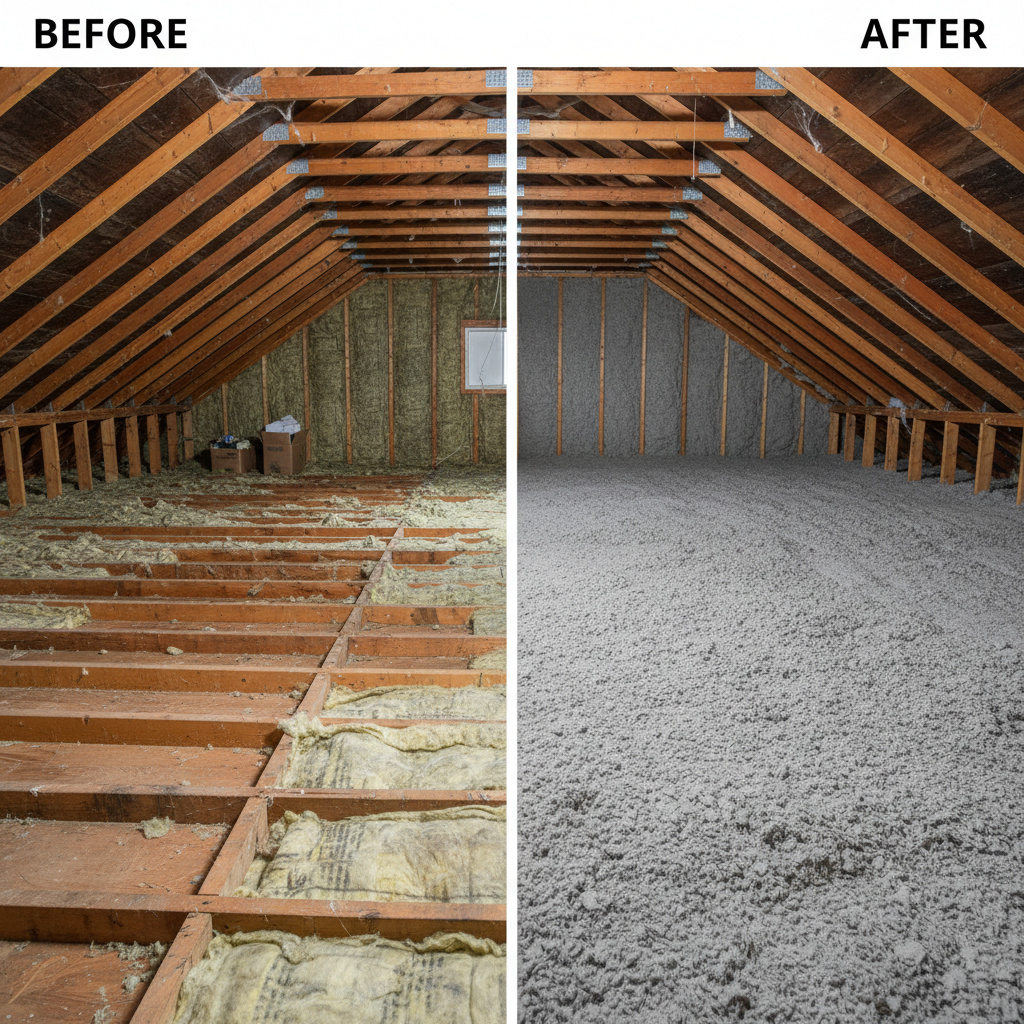
You can add insulation over existing material if:
- The existing insulation is dry, with no signs of moisture damage or staining
- There is no mold or active rodent activity
- The material is still relatively intact and hasn't significantly compressed or degraded
In these cases, blown-in cellulose or blown-in fiberglass can be added directly on top of existing batts to bring total depth to the recommended level. It's cost-effective and avoids the labor of a full removal.
Full replacement is necessary if:
- The existing insulation has absorbed moisture at any point — even if it appears dry now, moisture-damaged insulation rarely recovers its original R-value
- There is mold contamination, which poses both a performance and an air quality concern
- Rodent activity has contaminated the material with nesting debris, droppings, or urine
- The insulation is so severely compacted or degraded that adding over it would yield poor performance
If you're not sure which situation applies, a professional assessment will tell you definitively — and the cost of getting it wrong (insulating over a moisture problem) is much higher than the cost of a professional opinion.
Professional Attic Insulation Assessments
If your home never seems comfortable no matter how much you adjust the thermostat, your attic may be part of the problem — and the fix may be simpler than you think.
Metro NY Insulation has been serving homeowners in Bergen, Essex, Passaic, and Hudson counties in New Jersey, and Westchester County in New York, since 2005. We're BPI Goldstar Accredited and a NYSERDA partner, which means our assessments meet the standards required for utility and state incentive programs. Our professional assessments use thermal imaging cameras to detect hidden air leakage, precise depth measurement across the full attic floor, and airflow evaluation to confirm that ventilation is properly balanced.
For eligible New York homeowners, NYSERDA Comfort Home and EmPower+ incentives can significantly reduce the out-of-pocket cost of attic insulation upgrades — and we handle the paperwork. New Jersey homes are not covered by NYSERDA; they go through the Home Performance with ENERGY STAR program instead, which has its own incentive structure.
Schedule Your Free Attic Assessment
Frequently Asked Questions
How do I know if my attic insulation is bad?
There are two ways to spot the problem — in the attic and in your living space. In the attic, look for exposed joist tops (indicating thin insulation), material that's flat and compressed rather than fluffy, dark staining or fuzzy discoloration from mold, and evidence of rodent activity. In the living space, watch for upstairs rooms consistently hotter than downstairs, drafts felt near the ceiling on the top floor in winter, heating and cooling bills that keep climbing without any change in usage, and HVAC systems that run constantly without reaching the thermostat setting. If you're seeing symptoms on both sides, the case is strong that attic insulation is underperforming.
What R-value should attic insulation be in NJ and NY?
Both New Jersey and Westchester County fall within IECC Climate Zone 5A, where the recommended minimum attic insulation level is R-49. Most older homes in these areas were built with enough insulation to achieve R-11 to R-19 — a significant gap from current standards. Rockland County, which sits further north, can benefit from reaching R-60, particularly in homes with older construction and minimal air sealing.
Can attic insulation go bad over time?
Yes — and it happens more often than most homeowners realize. Fiberglass batts compress over time, losing R-value as they settle. Moisture damage — even a single event from a roof leak or condensation — can permanently reduce insulation performance. Rodent activity disrupts coverage and contaminates the material. Insulation installed in the 1970s and 1980s may now be performing at a fraction of its original rated R-value, even if it still looks like it's there.
How often should attic insulation be checked?
A general rule is every 10 to 15 years, or sooner if any moisture event has occurred — a roof leak, ice dam, or plumbing issue above the attic floor. In practice, many homeowners in older NJ and Westchester homes have never had their attic insulation assessed at all. If you've owned your home for more than a decade and have never looked, now is a reasonable time to check.
Why is my upstairs hotter than downstairs?
The primary cause in most homes is inadequate attic insulation. When the attic reaches 150 degrees F on a sunny summer day, that heat radiates downward through the attic floor into the bedrooms directly below — and your air conditioner can't fully overcome that constant radiant heat load. Ductwork running through a hot attic can also lose cooling capacity before it reaches the upper-floor registers. Learn more about why your upstairs gets hotter than downstairs and what actually fixes it.
Does attic insulation lower energy bills?
Yes, and often significantly. ENERGY STAR research shows that properly air sealing and insulating the attic can reduce heating and cooling costs by 20 to 40% compared to an under-insulated home. The actual savings depend on how low your current insulation level is, the size and configuration of your home, and local utility rates — but homes in NJ and Westchester with original 1960s or 1970s insulation typically see the most dramatic improvements.
Can I add insulation over old insulation?
Yes, provided the existing material is in good condition. If the insulation is dry, free from mold, and shows no signs of rodent activity, blown-in cellulose or blown-in fiberglass can be added directly on top to bring the total depth up to the recommended R-value. This approach is faster and less expensive than full removal, and it's the most common upgrade path for older homes that have some original insulation still in place.
Should I remove old attic insulation before adding new?
Only if the existing material is contaminated. Moisture damage, mold, or rodent activity are the three conditions that typically require full removal before new insulation goes in. Adding new material over compromised existing insulation traps the problem inside the building envelope and can lead to ongoing moisture issues, air quality concerns, and continued performance problems. If the existing insulation is in good condition, topping off is the more cost-effective approach and delivers the same long-term results.
Bottom Line: A basic attic inspection takes 15 minutes and can reveal whether your home's top comfort and energy problem is right above your ceiling. Look for exposed joists, compressed or damp insulation, gaps around the hatch and fixtures, and significant temperature differences. If your home is in NJ or Westchester County and was built before 1980, there's a good chance your attic insulation needs attention.